

In high-value asset areas such as data centers, semiconductor facilities, and precision instrument rooms, clean agent fire suppression systems are one of the key fire protection measures. However, the completion of system installation does not mean that its fire suppression performance has been verified.
Whether a clean agent fire suppression system can function effectively largely depends on whether, after a fire occurs, the extinguishing agent can be maintained within the protected area for a sufficient duration to achieve fire suppression and prevent re-ignition. If the room airtightness is insufficient, the agent may leak too quickly, affecting the actual protection performance of the system. Therefore, in engineering practice, Door Fan Test is commonly used to assess the integrity of the enclosure of the protected area and to predict the agent retention time.
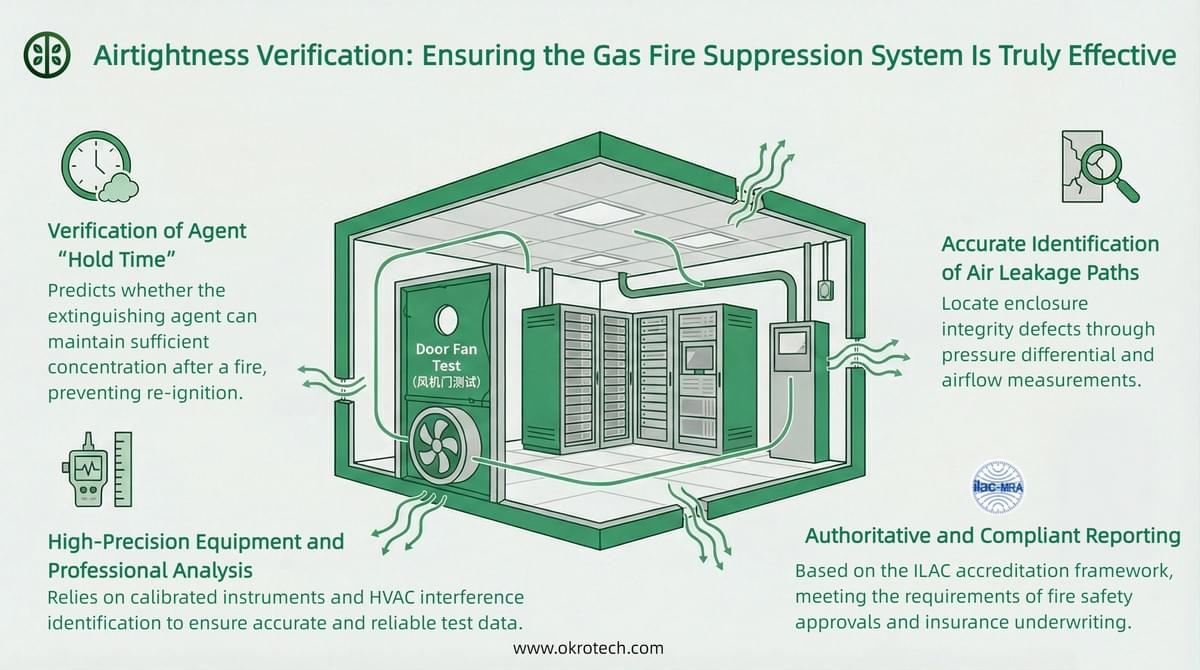
However, the quality of Door Fan Test services currently available in the market varies significantly, mainly in the following aspects:
1. Whether the equipment has been properly calibrated
Door Fan Test requires high accuracy in differential pressure and airflow measurements. If the testing equipment has not been properly calibrated, the results may not accurately reflect the room leakage condition and will directly affect the reliability of the retention time prediction.
2. Whether personnel possess professional competence
Door Fan Test is not merely a simple on-site operation; it also involves HVAC condition assessment, static pressure interference identification, data fitting, and result analysis. Whether the personnel have received systematic training and competency verification will directly affect the quality of the test.
3. Whether the report has credibility
If the test report is issued solely by the service provider without support from an accredited framework, it often lacks authority and acceptability in fire safety reviews, insurance underwriting, or international project compliance requirements.
4. Whether the process is traceable
A complete Door Fan Test should not only provide final conclusions but also retain on-site conditions, raw data, photographic records, and test process information to support subsequent review, rectification, and accountability.
The value of Shanghai OKRO lies not only in providing Door Fan Test services, but also in emphasizing standardized procedures, controlled equipment, qualified personnel, and traceable records to enhance the credibility of test results, while strengthening report compliance and external acceptance under an accredited framework.
For owners, general contractors, and project management teams, the effectiveness of a gas fire suppression system should not remain at the level of “installed,” but should be based on verifiable, traceable, and auditable technical evidence. The significance of the Door Fan Test is not merely to complete a test, but to provide a more reliable verification foundation for the integrity of the protected area and the performance of the system.