

Data centers, server rooms, UPS rooms, and network communication rooms are high-value, continuously operating IT equipment spaces. When selecting a fire protection system, it is not enough to only consider "whether it can extinguish fires"; more importantly, it must protect equipment, minimize downtime, avoid secondary damage, and provide a complete acceptance basis.
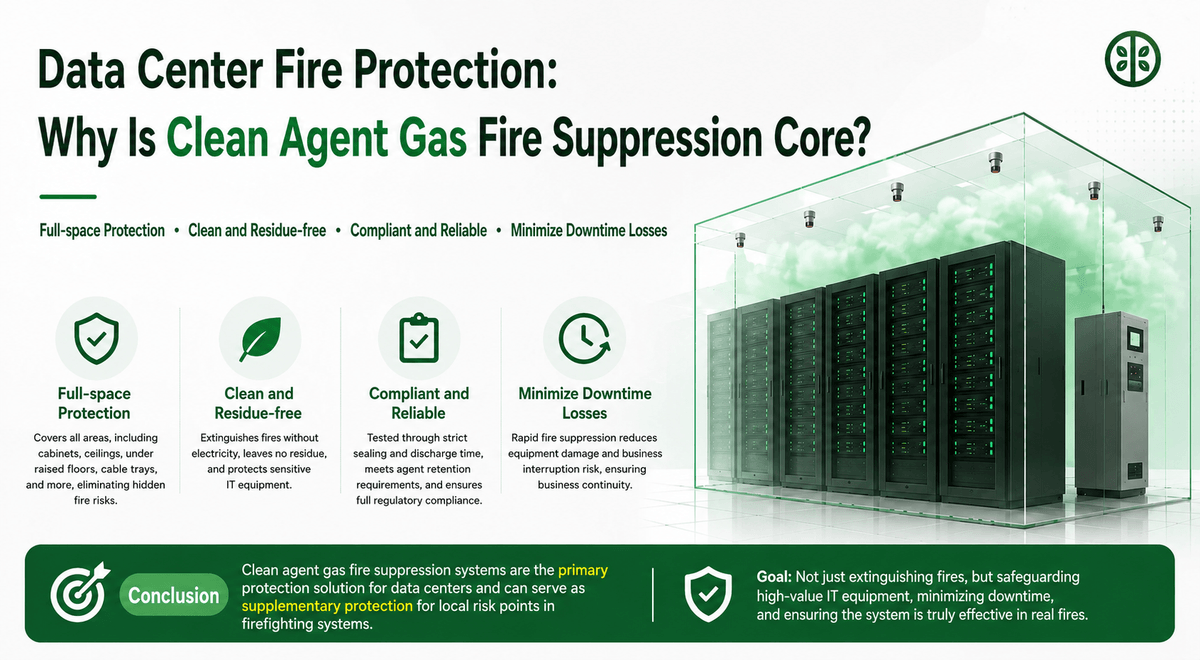
1. Data Centers Do Not Have Single-Point Fire Risks
Fire risks in data centers may occur in:
- Server cabinets;
- UPS equipment;
- PDUs / power distribution cabinets;
- Under raised floors;
- Above suspended ceilings;
- Cable trays;
- Cold aisles and hot aisles.
These risk points are widely distributed and concealed, making local fire extinguishing methods unsuitable as the sole solution.
A total flooding gas fire extinguishing system can form the designed fire extinguishing concentration throughout the protected space, making it more suitable for the overall protection of continuous spaces like data centers.
2. Data Center Equipment Is Vulnerable to Water Damage and Contamination
Servers, switches, storage devices, UPS units, and control modules are highly sensitive to water, dust, and residues.
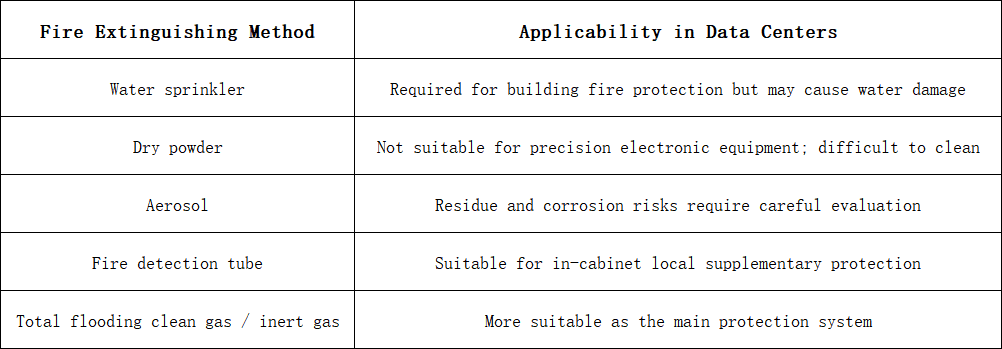
Clean gases or inert gases are generally non-conductive, leave no obvious residue, and enable quick recovery, better meeting the operational needs of data centers.
3. Total Flooding Systems Easier to Form a Compliance Closed Loop
Common total flooding gas fire extinguishing systems used in data centers include:
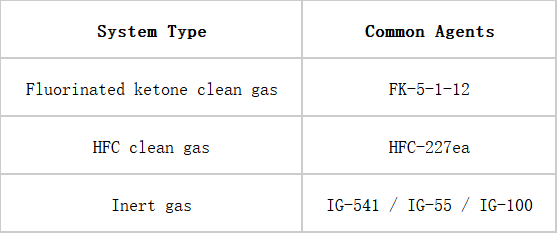
Relevant designs generally reference:
- NFPA 2001-2025 Standard on Clean Agent Fire Extinguishing Systems;
- NFPA 75-2024 Standard for the Fire Protection of Information Technology Equipment;
- ISO 14520 series Gas fire extinguishing systems;
- EN 15004 series Fixed gas fire extinguishing systems.
Total flooding systems typically require completion of:
- Agent quantity calculation;
- Discharge time confirmation;
- Door Fan Test / Room Integrity Test;
- Agent retention time assessment;
- Pressure relief design;
- Alarm and linkage testing;
- As-built document review.
These items form a complete closed loop of design, construction, testing, and acceptance.
4. Fire Detection Tubes Can Be Used But Should Not Serve as Primary Protection
Fire detection tube systems are suitable for:
- Electrical cabinets;
- Control cabinets;
- Small equipment cabinets;
- Local high-risk equipment spaces.
However, the protection scope of fire detection tube systems is usually limited by cabinet boundaries and installation locations, making it difficult to cover the entire data center space.
Therefore, the more reasonable system positioning is:
Total flooding gas fire extinguishing system as the primary protection for data centers; fire detection tube systems as supplementary protection for in-cabinet or local equipment.
5. Technical Recommendations from Shanghai OKRO
For data center projects, focus on the following:
- Main equipment rooms, UPS rooms, and communication rooms should adopt total flooding clean gas or inert gas systems.
- Local risk points such as power distribution cabinets and control cabinets can be equipped with fire detection tube systems as supplementary protection.
- For total flooding systems, focus on verifying air tightness, agent quantity, discharge time, pressure relief, linkage functions, and as-built documents.
- Third-party inspections shall conduct compliance verification based on approved design documents, product data, on-site installation status, and test records.
Conclusion
The priority of fire protection in data centers is not only to extinguish fires but also to protect high-value IT equipment, reduce downtime, and ensure the system functions effectively in real fire scenarios.
Therefore, data centers are better suited to adopt total flooding gas fire extinguishing systems as the primary protection method; fire detection tube systems are more appropriate for local supplementary protection.